Friday, 21 February 2020

Stepping into Tradition

Good morning.  It is 10:10 and we have just arrived at the main square where the parade route has been set up.  Two giant loudspeakers are pounding out music, traditional, in a 2, 2 beat.  A few people have already arrived and are seated on chairs, obviously they know the routine and have come early to claim prime spots.  There are 2 little girls next to me in elaborate costumes -- one even has her hair sprayed gold to match her crown and sequined dress.

More people are arriving all the time.  It seems that the spectators are children under 5 -- all dressed up-- and adults, some with colourful leis, but mostly in normal clothes.  The snack sellers are zeroing in on the kids to entice them to lollipops or multicoloured popcorn.  Most people know someone and greet them with the usual kiss on both cheeks.  A red and white coordinated lady in a wheelchair pushes to the rope barrier beside me -- she will get a good view.  The assembly is getting into the spirit of the event, singing along with the canned music.

It's now 10:25 and the police arrive.  The officer on the motorcycle will clear the path in front of the parade.  The cameras are out.

A small group on stilts leads.  The groups that follow are usually in themed costumes -- many elaborate and obviously purchased for the occasion.  The 'sea' group has crabs, octopi, squid, starfish, shells, regular fish, kelp beds, sharks, manta rays, turtles and clownfish.

The children that follow, from kindergarten to highschoolers are decked out in every imaginable costume -- spacemen, pizzas, animals, clown, bumblebees, clocks, tetris bricks, fruits, knights, exotic dancers, etc, etc.  Many of the kids look like they would rather be somewhere else, but some are dancing to the beat and engaging the crowd by tossing confetti or streamers.

After more than an hour, the last of the adult groups have passed me by.  The crowd is dispersing.  All that is left is the litter.  It was a great parade!  See you next year.

Thursday, 20 February 2020

Jardim de Palacio de Sant'Ana

We did make it to the third garden.  It is the grounds of the official functions of the government here -- read signing of papers and diplomatic receptions.  It was built in the mid nineteenth century and we had to present identification and wear visitor badges.  And the decorative gardens, now in their early spring finery, were decked out in pansies. 

But..... the trees on the property are spectacular!  The Pohutukawa is deemed the most notable in the garden and it is amazing.  It's like a cave and fort and climbing structure all in one.  The low hanging branches have grown roots and then developed into shoots of their own.
The specimen trees of many kinds of myrtle, camellia, cryptomeria, rhododendron, magnolia, kauri, paper bark tea tree have been enjoying the park for decades and stand waiting to be admired.  And admire we did!

Wednesday, 19 February 2020

A funny thing happened on the way to the garden....

Yes,  this morning Ian suggested that we visit the third of the major city gardens, but on our way we passed by a door which we had usually seen closed.  The sign by the door said 'Museu Carlos Machado'.  It turned out that this was the first of three museums started by Mr. Machado.  This was a sacred museum in a former convent featuring the most intricate altar wood carving in Portugal.  A significant claim, but it certainly topped any that I have seen.

The second museum was down the block and featured natural history.  In the front lobby was a stuffed white shark and upstairs there were thousands of birds, dozens of mammals, vials of fish, even snakes and stuffed lizards.

After lunch, we tackled the third museum which displayed sculptures of Canto do Maya.  He worked in clay and was mostly interested in the human form.

At least as interesting as the displays were the two gentlemen who walked around with us (making sure we didn't touch anything) but who were eager to discuss their exhibits and just about anything else that we wanted to ask.  We came away just before 5 pm with better perspectives on Azorean culture and the everyday life of the people, past and present.  A day well worth our 7 euro investment.  And the garden will be there another time.

Monday, 17 February 2020

A Sense of Accomplishment

When my sonny was about 14 years old, he dreamt of a sportscar for his 16th birthday.  Bad parents that we were, he was informed that even if we could afford it, he wasn't getting one.  Beside the safety issue, there was the more important philosophic one which revolved around our belief that something unearned was not nearly as valued as something accomplished.  If he wanted a sportscar, he would have to achieve it for himself.

And having something to accomplish is important for everyone, at every stage of life, even when you are 68 years old.  Today I rode over the top of the island and down to the north coast for the first time in 2 years.  I am at that age, when you are never sure how time will sap your strength of will or muscles, so I worked up to today's adventure with my cycling forays last week.  Once I had gone most of the way up the mountains, but that was only up and down.  To reach the north coast, it was up and down, twice. 

North shore achieved!

World (Class) Garden

The Furnas valley is actually the remains of a volcanic caldera.  It is approximately 7 km across and for the last 200 years, has been the site of thermal spas and gardens.  Terra Nostra park does contain thermal pools for bathing, but it was not to take the iron rich waters, that I took the 1.5 hr bus ride to Furnas.  Terra Nostra is a park (12.5 hectares) with a collection of world plants to rival any that I have seen. 

It being winter, the ginko baloba avenue was leafless.  There were no waterlilies blooming in the pools.  The tulip trees only had the stubble of flowers on bare stems.  The flower gardens which are artistically designed in summer were brown and plantless.  The bromeliad garden only showed 2 blooms.  The acer palmatum were grey sticks.  Only one magnolia held out a huge pink saucer to be admired.

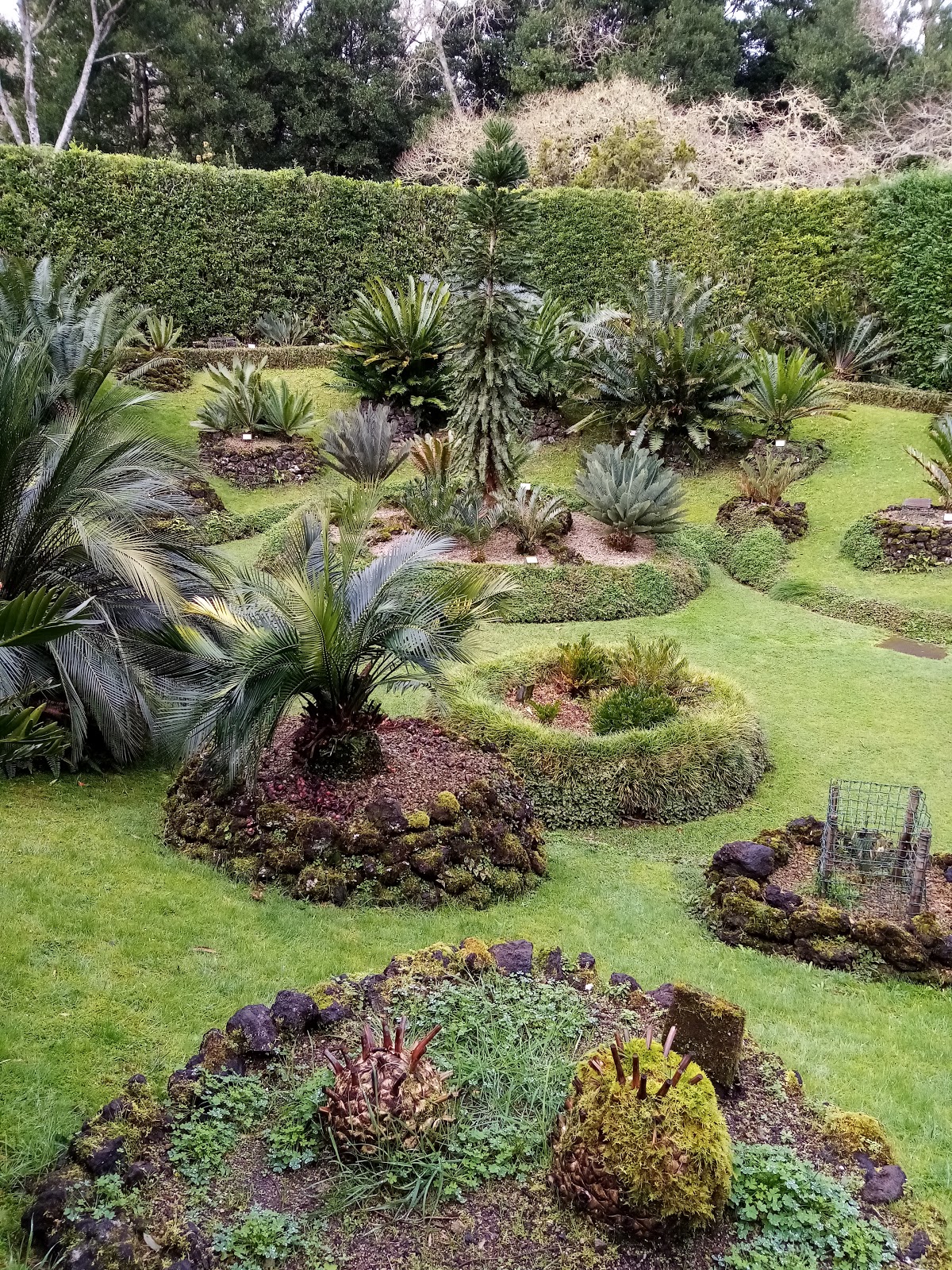
But the pahutukawa showed their needle-like blooms confirming their other name as the New Zealand Christmas tree.  The cycad collection looked as unplantlike as ever.  The eucalyptus was easily identifiable by the twisted bark and the monkey puzzle was as prickly as any.  The Vireya garden of Malaysian rhododendrons was decked out in colours from white to pink, to orange to purple.

And among the trees as well in their own protected enclosure, the camellias flaunted blossoms in such variety and colour to put all other flowers to shame.  There are more than 600 species and cultivars from all over the world.  I was not the only admirer; there was a constant hum of bees visiting as well. 

Furnas was a stop on a tour that Ian, Duane and I did two years ago, so I had already visited the bubbling pools and sampled the mineral water, but this past weekend was the camellia show.  I was a little skeptical as to how important it was to see the blooms in the local casino building (just an exhibition hall).  With just a one euro admission, my expectations sank even lower and when the first room I entered had nothing but vendors selling everything from tarts to fishscale ear rings, I almost turned and left.  But nothing prepared me for the display in the center room.  There were 6 huge planters, each with a live, flowering camellia in the center and then dozens of labeled blooms stuck in the volcanic gravel around it.  I went around, time and time again, trying to take in all the nuances in petal form, stamen configuration, sizes, colour variegation, and even scents.  At the front of the room was a wall fountain with some of the most unique flowers displayed on a ledge or floating in the pool.  I have never seen a collection like it!


Saturday, 15 February 2020

Island life

We have been asked "Why Azores?"  That usually comes after "Where are the Azores?" My standard answer is "a warm ocean place, very low-key, with a european flavour and a direct 5 hour flight from home".

Although one has to leave via the large and busy Toronto airport, the next stop is a little landing field on the south coast of a green spot in the ocean.  There is no retractable gate and ramp -- you walk on the tarmac to John Paul II airport terminal.  The taxi ride to town is 10 euros.

Last year, the Hotel Gaivota (seagull) was under renovations and we stayed at a very nice place a few streets up from the harbour, but being down on the waterfront is our favourite spot.  We have a corner room up on the 5th floor with a spectacular view of the eastern section of the busy harbour.  We watch the pilot boats go out to greet the Trans Insular container ships, and the cruise boats back in onto the long dock.  The fishing boats usually come home mid afternoon.  The loading and unloading of cargo goes on into the night and then the big working ships silently sneak out heading to the next set of islands with their supplies from the mainland.  There is a steady traffic here, as it is the largest port for the archipelago of nine islands which make up the independent region of the Azores.

Breakfast is provided in the hotel from 7:30 to 10:30 and has all the standard items of meat and cheese and eggs.  There is fruit and cereal and yogurt and a local pastry each morning.  My idea of being on vacation means that someone else prepares breakfast and this fits the criteria very nicely. 

We have a choice of regular activities -- grocery shopping for soup or salad ingredients along with fresh bread and some cheese.  Each of the islands produces at least one unique variety, and though there is no blue or brie, the spectrum of flavour and texture is huge.  Ian usually has a local sausage or seafood to accompany his meal, but I have not had any meat in over a week.  Now, restaurants do a magnificent job of preparing beef (all those old dairy cows), so I am not avoiding meat for vegetarian sake, it's just there are so many wonderful alternatives.  The bananas and oranges are local, but the only pears are variety Roca, which come from the mainland.

And there is bike riding for both of us this year.  Ian picked up a basic model at Decathlon upon our arrival and I have the loan of the bike which I purchased two years ago, and we are off.  Now, there is a relatively flat route from here along the coast to Lagoa, about  8 km away and much of it is a marked bike path along the ocean.  On the sections where one must be on the road, the drivers are quite courteous and one doesn't feel unsafe pedaling.  It can be challenging with short steep rises and gusts of wind from the sea, but the views are spectacular and the crash of the waves, mesmerizing. 

Decathlon is a destination for every kind of sport imaginable and the gear to go with it.  You can swim, hike, fish, hunt,  cycle, play soccer, work out, trek, rollerblade, sail, play tennis or badminton, do ballet, or whatever.  The prices are very reasonable and they have sizes from little kids to big adults. 

Poking around town is a pleasure.  With very narrow cobble streets and even narrower sidewalks, the place has a very old world field.  (Europeans have been here since 1432).  There are a significant number of units for sale, and, if one can believe the internet, large numbers of abandoned homes.  The government has initiated a 'Come home to Portugal' campaign and some of the people which left in the 60s for the USA and Canada, are returning. 

We go for a walk on the waterfront after dinner.  The lights are bright on the ships in port, there are fish jumping in the dark, some of the cafes still have diners, joggers use the paths.  It is peaceful with clean air, generally about 16 degrees.  We have been told that in the summer, the tourists overrun the place, but there is no sign of that in February.  What a delight!


Wednesday, 12 February 2020

Picking wildflowers

Having been raised on a farm, there was, and still is, an appreciation of the generosity of nature.  The garden produce in terms of bushels of green and yellow beans, was processed and became our food in the winter.  Despite being unsprayed and therefore often accompanied by worms, apples became sauce and the jars lined the fruit cellar along with peaches and pears.  On the larger scale, wheat and oats and barley were stored in bins to be ground into a coarse flour which was fed to the pigs.  Bales and bales of hay were gathered from fields and stacked in the barn above the cows, ready to be dropped through the floor and enjoyed by the bovines all winter.  My Father planned tilling and fertilizing to optimize yields and perpetually fretted over the weather.  The connection between what grew and our life was very real.

But the blessings of nature were also so much more than just the food we gleaned or the profits farming brought.  My Mother had flower gardens, and when I was old enough and interested enough, I had my own garden when I tended my favourites, lupins and foxgloves among the plantings of forsythia and honeysuckle.  In the early spring there was a burst of daffodils, followed by peonies with their extravagant blooms so large that without support, the red mops drooped to the ground.  Marigolds were an easy summer annual, lasting well into the fall.  One section was devoted to four-o-clocks which opened on time every afternoon. My love of gardening grew.

In my own homes, there were always gardens, successes and failures.  I remember pulling out an entire bed of oriental poppies because I thought they were thistles growing.  My first contact with a hosta I tried hacking out at the side of the swimming pool we inherited in London -- unsuccessful.  When I couldn't get rid of it easily, I decided to embrace it and even brought it to the house in Millgrove to anchor the rock garden against erosion.  Rhodies and azaleas totally astounded me and therefore received prime spots in the gardens. The standard joke was that I should just wrap the whole garden in burlap -- it would be easier than doing all the rhodies and azaleas separately.  Even now, the azaleas along the side of the house get special chicken wire cages to protect them from the rabbits.

But there is something very special about fruit or flowers freely received.  The apples along the trail or the black raspberries on the roadside are a totally generous gift of the natural world.  When I walk with the grandchildren, in Hamilton or in Sweden, we pick wildflowers and delight in the variety and colour. 

And so, yesterday, having slowly made my way up the mountain in my granny gear, beside the field with cows, I picked three different roadside flowers, stuck them in my pack and carefully pulled them out back at the hotel.  They are not as perfect as ones I could buy, but they embody nature's generosity and the beauty of this island.